

What Every First-Time Mum Wishes She'd Known Before Labour
There’s a particular kind of nervous excitement that settles in during those final weeks of pregnancy — a mix of “I can’t wait to meet my baby” and “I really hope I know what I’m doing when it actually happens.” If that sounds familiar, you’re in very good company.
The truth is, no matter how many birth stories you’ve read, how many antenatal classes you’ve attended, or how many times you’ve mentally rehearsed your breathing techniques, labour has a way of unfolding entirely on its own terms. And that’s not a reason to worry — it’s actually something worth embracing.
We’ve gathered the kind of honest, heartfelt advice that mums who’ve been through it often wish someone had shared with them beforehand. Not to scare you, and not to overwhelm you — but to help you feel a little more grounded, a little more prepared, and a lot more reassured that whatever happens, you’re more capable than you know.
Labour Rarely Follows a Neat Timeline — And That’s Completely Normal
One of the biggest surprises for many first-time mams is just how unpredictable the timeline of labour can be. You might have heard that active labour lasts an average of eight hours for first-time mums — and while that’s technically true, it’s really just an average. Some labours are much shorter. Many are considerably longer. Early labour alone can last anywhere from a few hours to a couple of days.
This is something midwives and maternity staff will understand completely, but it can catch first-time mams off guard. You might arrive at the hospital full of adrenaline, only to be told you’re still in early labour and to go home and rest. Or things might progress faster than anyone expected. Both are normal. Both happen all the time.
Try not to measure your progress against a fixed clock. Your body is doing something extraordinary at its own pace, and that pace is the right one for you and your baby.
Your Birth Plan Is Valuable — But Keep an Open Mind
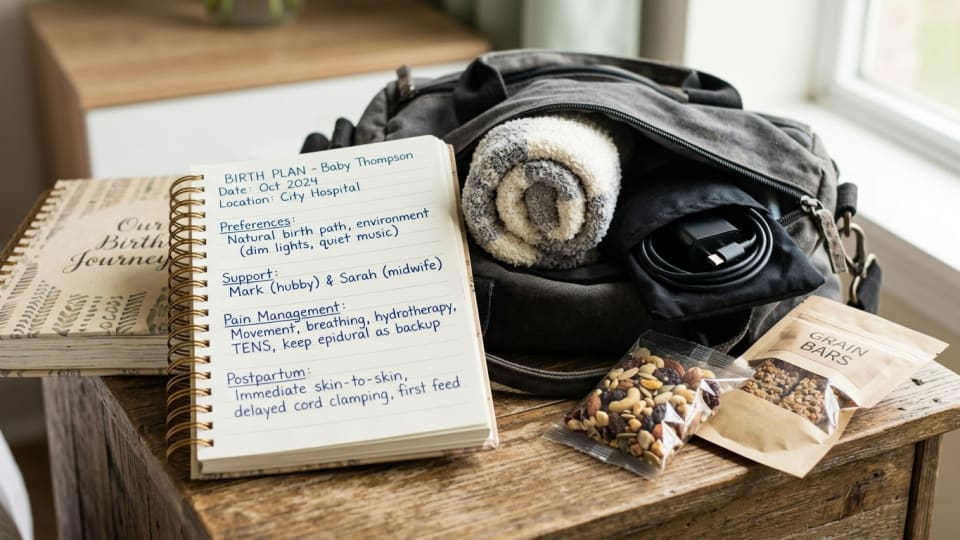
Writing a birth plan is a really worthwhile exercise. It helps you think through your preferences, have conversations with your partner or birth support person, and communicate your wishes to your care team. Many maternity hospitals in Ireland actively encourage them.
That said, the mums who tend to find labour least stressful are often those who hold their birth plan loosely. Think of it as a set of preferences rather than a script. If circumstances change — and sometimes they do — being able to adapt without feeling like you’ve “failed” makes an enormous difference to how you experience the birth.
It can help to think about your non-negotiables (the things that matter most to you) versus your preferences (things you’d like if possible, but aren’t essential). Share both with your midwife when you arrive, and trust that your care team wants the best outcome for you and your baby.
The Practical Bits That Make a Real Difference
Every mam who’s been through labour has at least one “I wish I’d packed that” moment. Here are the practical things that often get overlooked:
-
A phone charger (or a power bank). Your phone battery will not last as long as your labour. Bring both if you can.
-
Snacks — for you and your birth partner. Hospital vending machines are notoriously unreliable, and your support person needs to keep their energy up too. Think cereal bars, fruit, crackers, and something with a bit of sugar for when things get intense.
-
A change of clothes for your birth partner. Labour can be long. No one wants to spend 20 hours in the same outfit.
-
Your own pillow. Hospital pillows are functional. Your own pillow is comfort. It matters more than you’d think in the early hours after birth.
-
Something to do during early labour. A downloaded series, a playlist, a podcast, a good book — early labour can involve a lot of waiting, and distraction genuinely helps.
-
Lip balm. This one sounds small but ask any mum who went through labour with dry, cracked lips during the pushing stage — it’s on every list for a reason.
-
Loose, comfortable clothing. You’ll be examined regularly, and comfort matters far more than appearance at this stage.
Pain Relief: Know Your Options Before You Go In
There’s no medal for doing labour without pain relief, and there’s no shame in knowing exactly what you’d like from the start. Ireland’s maternity hospitals offer a range of options — from TENS machines and gas and air (Entonox), to epidurals and pethidine — and it’s worth understanding what’s available at your specific hospital before the day.
Many mums find that their feelings about pain relief shift significantly once labour is underway. You might feel strongly about going medication-free during pregnancy, and then find that an epidural is exactly what you need to rest and gather strength. You might plan for an epidural and find that you’re coping better than expected without one. Both are valid. Both are brave.
What helps is understanding your options in advance so that when the time comes, you can make an informed decision based on how you’re actually feeling — not what you thought you’d feel.
The Emotional Reality Can Surprise You
Labour is physically intense, but the emotional experience is something many mums don’t talk about quite as openly. You might feel incredibly focused and powerful. You might feel frightened or overwhelmed at points. You might laugh, cry, or say things that don’t quite sound like you. All of this is completely normal.
Many parents find that the moments they feared most — the transition phase, the pushing stage — were actually more manageable in the moment than in anticipation. The body has a remarkable way of coping when it’s actually in the experience rather than imagining it.
It can also be worth preparing yourself emotionally for the fact that the experience might feel very different to anything you imagined — not necessarily worse, just different. Some mums describe feeling completely in the zone. Others describe it as the hardest thing they’ve ever done. Most describe it as both, at different points.
Lean on Your Birth Partner — That’s What They’re There For
If you have a birth partner — whether that’s your partner, a family member, or a friend — their presence genuinely matters. Research consistently shows that continuous support during labour leads to better outcomes and a more positive birth experience.
It helps to have a conversation with them before the day about what you might need. Some mums want physical touch — a hand to hold, a back to rub. Others want quiet company. Some want encouragement and words of reassurance. Some want all of the above at different stages. Let them know, and give them permission to advocate for you if you need them to.
If you’re going in without a birth partner, know that your midwife is there to support you too. Ireland’s midwifery teams are experienced, compassionate, and used to supporting mams through every kind of birth situation.
Trust Your Instincts and Your Care Team
During labour, you’ll be surrounded by people whose entire focus is your safety and wellbeing. If something doesn’t feel right, say so. If you have a question, ask it. If you want to understand why something is being recommended, that’s completely reasonable to ask.
At the same time, try to lean into the expertise of the people around you. Midwives and obstetricians have seen thousands of labours. Their guidance comes from experience and care — and working with them rather than against them makes the whole experience smoother for everyone, especially you.
After the Birth: The First Hour Is Special (and Sometimes Overwhelming)
If all goes well, the hour or so after birth — often called the “golden hour” — is a time when skin-to-skin contact with your baby is encouraged. This can be a truly magical moment, but it’s also worth knowing that not every mam feels an instant, overwhelming wave of love the moment their baby arrives.
Some do — and it’s every bit as beautiful as it sounds. But others feel shock, exhaustion, relief, or a strange sense of detachment before the love settles in. All of these responses are normal. Bonding is a process, not a single moment, and however you feel in those first minutes does not define your relationship with your baby.
Whatever Way Your Birth Unfolds, You’re Doing Brilliantly
However your labour goes — whether it’s the straightforward birth you hoped for, or something that took a few unexpected turns — the most important thing to hold onto is this: you did it. You grew a whole human being, you navigated one of the most intense experiences a person can go through, and you met your baby on the other side.
There is no right way to give birth. There is no version of labour that makes you more or less of a mother. A caesarean section is not “the easy way out.” An unmedicated birth is not the only valid choice. Every birth story is its own story, and every single one of them matters.
Give yourself grace before the day, during it, and after. You’re doing something remarkable — and you’re more ready for it than you feel right now.