
Three in four Irish adults want age limits on energy drink sales
If your teenager has ever come home buzzing with more energy than seems humanly possible after school — or if you’ve spotted them cracking open a giant can of something neon-coloured before football training — you’re not alone in feeling uneasy about it. New research from Safefood published today confirms that those gut instincts are well founded, and that most of the country agrees with you.
A major new report has found that 77% of adults in Ireland support introducing a legal age restriction on the sale of energy drinks to children. And when you look at the figures behind that headline, it’s not hard to see why.
The numbers that’ll make you put down your coffee
More than half of 15- to 24-year-olds — 54% — are drinking energy drinks at least once a week. One in eight in that age group (12%) are drinking them every day. Among parents of children under 18, 11% said their child consumes energy drinks at least weekly.
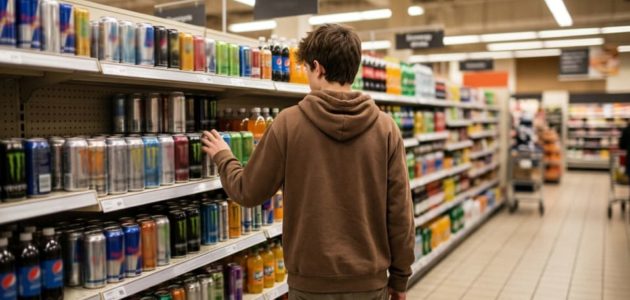
The market itself has nearly doubled in the past decade. There are now 77 energy drink products available in Irish supermarkets, up from just 39 in 2015. And the cans have got bigger. Back in 2019, 60% of products came in 250ml cans. By 2026, 55% are sold in 500ml cans — meaning kids are drinking more sugar and caffeine in a single sitting than ever before.
How much more? The average sugar content per serving has risen from 22.6g in 2019 to 30.9g now — that’s roughly eight teaspoons of sugar in one can. Three products surveyed contained between 65g and 70g of sugar per serving. That’s up to 17.5 teaspoons of sugar in a single drink.
On the caffeine side, the average energy drink contains 115mg per serving — equivalent to about 1.4 espressos — while some products go as high as 200mg, or around 2.5 espressos. For a child or teenager whose body is far more sensitive to caffeine than an adult’s, that’s a significant hit.
Knowing isn’t the same as stopping
What makes the Safefood findings particularly striking is this: almost everyone surveyed — 97% — was already aware that energy drinks can negatively affect sleep, concentration and mood in children and young people. Nearly all of us know. And yet consumption remains high.
Dr Joanne Ui Chrualoaich, CEO of Safefood, put it plainly: “One of the most striking findings from this research is that almost all those surveyed know energy drinks can have negative health effects, yet many people continue to drink them regularly. It’s notable that the number of energy drink brands on sale in supermarkets has almost doubled over the last 11 years. This is a significant increase in availability.”
Dr Aileen McGloin, Director of Nutrition at Safefood, added: “What many people may not realise is just how much sugar and caffeine they can get from a single energy drink. As serving sizes have grown, some products now contain the equivalent of up to 17.5 teaspoons of sugar and as much caffeine as two and a half espressos.”
She also offered a gentle reminder of what actually works for energy: “Eating regular, balanced meals, staying well-hydrated and getting enough sleep are healthier and more sustainable ways to do it. When it comes to hydration, water is always the best choice.”
What happens next
The report has been shared with the Department of Health. Minister for Public Health Jennifer Murnane O’Connor welcomed the findings, saying: “Protecting the health and wellbeing of children and young people is a priority for both the Government and the Department of Health. The sale and consumption of stimulant drinks remains a concern, especially given how popular these products are with younger age groups.”
She added that the research “will help inform evidence-based measures to protect and improve the health of people across Ireland.”
For now, if you want to check exactly how much sugar and caffeine is in a specific drink your child might be reaching for, Safefood has an online tool worth bookmarking: safefood.net/healthy-eating/energy-drinks-checker.
It might be a handy thing to look at together with your teenager. Not as a lecture — just as a conversation starter. Sometimes the facts do the talking for you.