
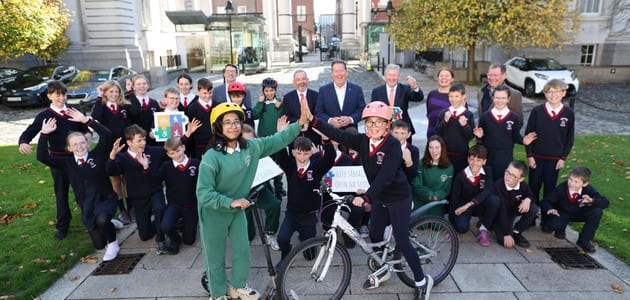
Ireland's Safe Routes to School Programme just added 83 more schools nationwide
If you’ve ever stood at the school gate watching a river of cars crawl past while your child clings to the inside of the footpath, you’ll know exactly why this matters. Ireland’s Safe Routes to School Programme has just added another 83 schools to its ranks, bringing the total number of participating schools nationwide to 609 — and making it one of the largest school active travel programmes in the whole of Europe.
The announcement was made this week by Minister for Transport Darragh O’Brien alongside Ministers of State Seán Canney and Jerry Buttimer, and the National Transport Authority (NTA). Every county in Ireland has schools included in this latest round, Round 5, which means this isn’t just a Dublin thing. It’s nationwide, and it’s growing.
What the programme actually does
The Safe Routes to School Programme isn’t just a well-meaning government initiative that lives on a PDF somewhere. It delivers actual, physical changes around school entrances and approach roads — think new cycle paths, upgraded footpaths, improved pedestrian crossings, traffic calming measures and those distinctive pencil-shaped bollards and colourful road markings that are starting to appear around schools all over the country.
For rural schools on higher-speed roads, the programme takes a tailored approach with prominent signage and road markings specifically designed to alert drivers and encourage them to slow down. Nine of the 83 newly added schools fall into this category.
The programme is coordinated by the Safe Routes to School team at An Taisce, working in partnership with all 31 local authorities, schools and local communities. More than €50 million has been invested since the programme launched in 2021, with a further €24 million allocated for 2026.
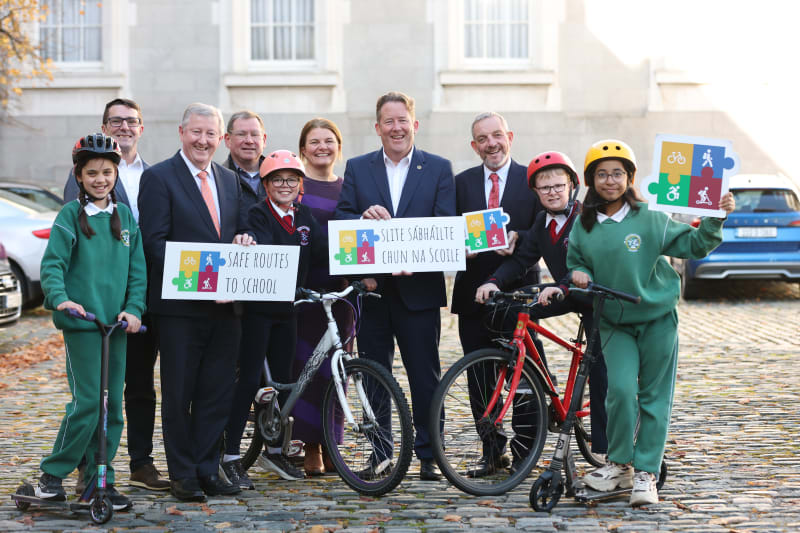
Safe Routes to School launch with children and officials.
It’s already making a difference
The numbers coming back from schools where infrastructure has already been completed are genuinely encouraging. Surveys covering almost 1,700 students show that cycling to school has jumped by nearly 49%, scooting is up 17.5% and walking has increased by 8%. Car use, meanwhile, has fallen by more than 10%.
Minister O’Brien pointed to the most recent census as further evidence the programme is working, noting it showed “the first increase in children walking to school in a generation.” That’s not a small thing. For years the trend has been in the wrong direction, with more and more families defaulting to the car drop-off even for short journeys. Changing that habit takes infrastructure, not just persuasion.
Anne Shaw, CEO of the National Transport Authority, described the wider impact: “By creating safer, more accessible and more welcoming streets around schools, we are making it easier for children to walk, wheel and cycle while giving parents greater confidence in how their children travel. The positive changes we are seeing go far beyond the school gate, helping to build healthier habits, reduce traffic congestion and create stronger, more connected communities.”
Where things stand right now
To give a sense of how much is already in motion across the country, here’s the current breakdown of programme delivery:
-
189 school zones fully completed
-
42 projects currently under construction
-
83 at preconstruction design stage
-
19 at public consultation
-
110 at preliminary design
-
81 at options development
On top of the infrastructure work, 665 schools that applied to the programme have already received cycle parking — a small but practical change that can make a real difference to families wondering whether cycling is actually viable on a wet Tuesday morning in October.
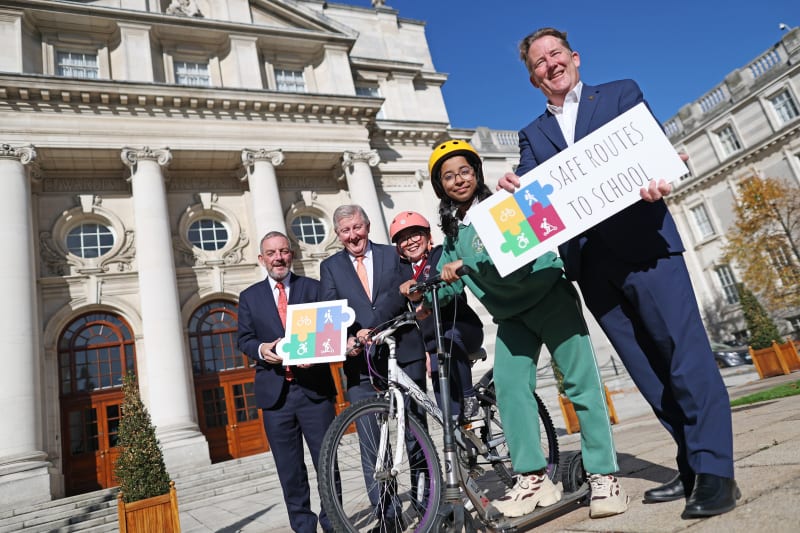
Safe Routes to School launch event.
When the programme launched in 2021, 932 schools applied — nearly a quarter of all schools nationally. The goal is to bring all of those applicant schools into the programme on a rolling basis. With 609 now included, progress is being made. Thomas Connell, Programme Manager at Safe Routes to School, put it well: “Together with our delivery partners, we remain focused on supporting every participating school to make active travel a safe and practical daily choice.”
To find out if your child’s school is among those included in Round 5, the full list of schools is available through the Safe Routes to School website.