

How to Ease Pregnancy Anxiety as Your Due Date Gets Closer
The nursery is ready, the hospital bag is packed, and your due date is circled on the calendar — and yet, instead of feeling excited, you find yourself lying awake at 3am running through every possible “what if.” If that sounds familiar, you are absolutely not alone. Anxiety in the final weeks of pregnancy is incredibly common, and it doesn’t mean anything is wrong. It simply means you’re a parent who cares deeply.
Whether this is your first baby or your third, the lead-up to labour can stir up a swirl of emotions that nobody really prepares you for. The closer that date gets, the more real it all becomes — and with that reality can come a wave of worry that catches even the most prepared mum-to-be off guard.
Here’s what you should know: those feelings are valid, they make complete sense, and there are gentle, practical ways to help yourself through them.
Is It Normal Nerves or Pregnancy Anxiety?
There’s a difference between the butterflies-in-your-stomach nervousness that comes with any big life event, and anxiety that starts to feel heavy or unmanageable. Both are more common in pregnancy than many people realise — in fact, research suggests that anxiety during pregnancy affects roughly one in five women, and it often peaks in the third trimester.
Some signs that what you’re experiencing may go beyond everyday nerves include:
-
Persistent, racing thoughts that are hard to switch off
-
Difficulty sleeping even when you’re exhausted
-
Feeling on edge or irritable most of the day
-
Physical symptoms like a tight chest, shallow breathing, or a churning stomach
-
Avoiding thinking or talking about the birth because it feels too overwhelming
-
Reassurance-seeking that doesn’t actually make you feel better
If you recognise several of these, it’s worth mentioning it to your midwife or GP at your next appointment. You don’t need to be in crisis to ask for support — reaching out early is always the right call.
Why the Final Weeks Can Feel So Overwhelming
There are very real reasons why anxiety tends to build as your due date approaches. You may be worried about the labour itself — the pain, the unpredictability, whether things will go to plan. You might have fears about the health and safety of your baby. Some mums-to-be feel anxious about the enormous identity shift ahead, especially with a first baby. Others carry worries about older children at home, financial pressures, or relationship dynamics changing.
All of this is completely understandable. Pregnancy asks a huge amount of you — emotionally, physically, and mentally — and the final stretch can feel like all of those pressures arriving at once.
Simple Techniques That Can Help Day to Day
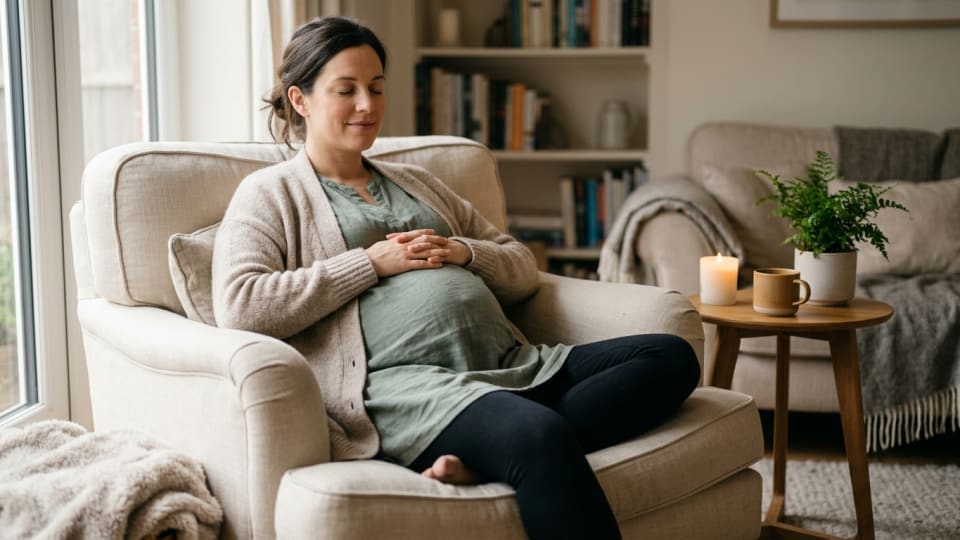
You don’t need to overhaul your life or take a week-long retreat to find some calm. Small, consistent practices can make a real difference to how you feel from one day to the next.
Slow, mindful breathing is one of the most effective tools available to you — and it costs nothing. Try the 4-7-8 method: breathe in for four counts, hold for seven, and breathe out slowly for eight. It activates your body’s natural calming response and can help in moments when anxiety spikes suddenly.
Grounding exercises can bring you back to the present when your mind starts spiralling into worst-case scenarios. The 5-4-3-2-1 technique is a popular one: name five things you can see, four you can hear, three you can touch, two you can smell, and one you can taste. It sounds simple, but it genuinely works to interrupt anxious thought patterns.
Gentle movement — a short walk, some light pregnancy yoga, or even just stretching in the sitting room — can shift your mood more than you might expect. Movement releases endorphins, helps ease physical tension, and gives your mind something concrete to focus on.
Limiting doom-scrolling is worth considering too. It’s tempting to search for birth stories online late at night, but it’s often the difficult ones that stick in your memory. Curating what you read and watch in these final weeks is a small act of self-care that really adds up.
Talk About It — Don’t Go It Alone
Many mums-to-be feel reluctant to voice their anxieties, worried they’ll seem ungrateful or dramatic when, on the surface, everything is going well. But bottling up worry tends to make it grow, and talking — to a partner, a close friend, your mam, or another parent — can bring enormous relief.
If you’re attending antenatal classes, this can be a wonderful space to share how you’re feeling with others who are at exactly the same stage. Knowing that the woman sitting next to you is lying awake worrying too can be surprisingly comforting. Many hospitals and community midwifery services in Ireland offer group antenatal programmes where this kind of peer support happens naturally.
If your worries feel bigger than conversation can hold, please do speak to your midwife or GP. Perinatal mental health support is available in Ireland, and there is no shame whatsoever in accessing it. Your emotional wellbeing matters just as much as your physical health during this time.
Preparing Practically Can Help You Feel More in Control
For some people, anxiety eases when they feel more prepared. If you haven’t already, it can help to write a birth preferences document (sometimes called a birth plan) — not because everything will go exactly as written, but because the process of thinking it through and discussing it with your midwife can make the unknown feel a little less daunting.
Knowing who to call if you think labour has started, having your hospital bag by the door, and talking through the logistics with your birth partner can all reduce that background hum of “what if I’m not ready.” You may not be able to control the birth, but you can control your preparation — and that counts for a lot.
Be Gentle With Yourself in These Final Weeks
The weeks before your baby arrives are a tender, in-between kind of time. You’re not quite where you were, and not yet where you’re going. It makes sense that they come with complicated feelings — anticipation, excitement, fear, and love all tangled up together.
Try to rest when you can. Accept the cup of tea someone offers you. Let the less important things wait. And remind yourself, on the hard days, that anxiety in these weeks is not a sign that something is wrong — it’s often a sign of just how much this matters to you.
You are doing something remarkable. And before long, you’ll be on the other side of this, looking down at your baby and wondering how you ever worried so much. You’ve got this.
If you’re feeling overwhelmed by anxiety during pregnancy, speak to your midwife, GP, or contact Nurture Health (nurturehealth.ie), an Irish charity offering perinatal mental health support and information.