

Essential water safety rules every Irish child should know
With the summer holidays on the horizon and the promise of days at the beach, lake, or local pool, water safety is something every Irish parent should have front of mind. Ireland is blessed with stunning coastlines, beautiful rivers, and countless lakes — but with that natural beauty comes real risk, especially for young children.
The good news is that teaching your child water safety doesn’t have to feel scary or overwhelming. With a few simple rules and regular conversations, you can help your child enjoy the water confidently and safely. Here’s everything you need to know to get started.
Why water safety matters so much
Drowning is one of the leading causes of accidental death in children, and it can happen in seconds — even in shallow water, and even with confident swimmers. Many parents are surprised to learn that children who can swim are still at risk, particularly in open water conditions that behave very differently from a controlled swimming pool environment.
In Ireland, our beaches, rivers, and lakes present unique hazards including strong currents, cold water shock, and rapidly changing tides. That’s why it’s so important that safety awareness goes hand in hand with swimming ability from a very young age.
Age-appropriate water safety for toddlers (under 5s)
For very young children, the most important rule is straightforward: they should never be near water without an adult within arm’s reach. Toddlers can topple into water silently and quickly, and even a few centimetres of water in a garden paddling pool can pose a risk.
Here are the key rules to establish early:
-
Always hold an adult’s hand near any water — pools, ponds, the beach, rivers, or even large puddles.
-
Never go near water without a grown-up — make this a non-negotiable rule from the very beginning.
-
Wear a properly fitted buoyancy aid when on boats or in open water — not just a pool toy or arm bands, which are not safety devices.
-
Empty paddling pools after every use and store them away or turn them upside down.
-
Fence off garden ponds or fill them in while children are young.
At this age, swimming lessons through programmes like the Irish Water Safety (IWS) Aquatics programme can be introduced in a fun, gentle way that builds familiarity and confidence in the water.
Water safety rules for school-age children (5–12)
As children grow and become more capable swimmers, it’s tempting to relax supervision — but this is also the age when children start pushing boundaries and taking risks. The rules evolve, but the conversations need to continue.
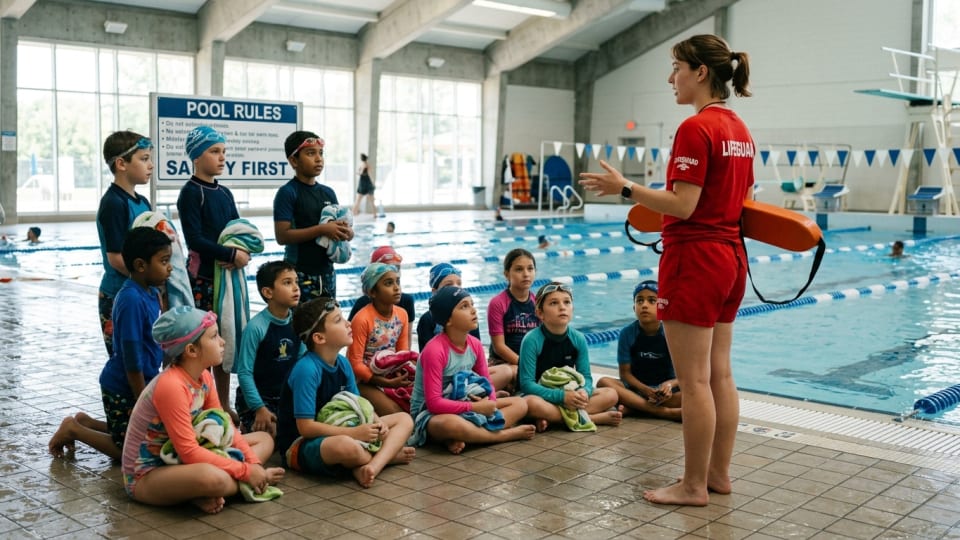
Key rules to teach your primary school-age child:
-
Always swim with a buddy — never swim alone, not even in a pool.
-
Only swim in designated, supervised areas — look for the blue flag or lifeguard presence at beaches.
-
Ask permission before entering any water — this applies to streams, rivers, lakes, and the sea, not just pools.
-
Know your limits — encourage children to be honest about how far they can swim and not to show off or try to keep up with older children.
-
Never push or jump on others in the water — pool etiquette isn’t just politeness; it’s safety.
-
Get out of the water if you feel cold, tired, or unwell — cold water can cause muscle cramps quickly, especially in Irish sea temperatures.
-
Shout for help — don’t go in after someone — teach children what to do if they see someone in difficulty. Shout, reach (with a stick or rope), throw (a ring buoy), never jump in.
Open water safety: beaches, rivers, and lakes
Open water swimming is a very different experience from a pool, and parents should help children understand those differences. Our coastal waters are beautiful but they can also be cold, unpredictable, and powerful.
Things to teach children about open water:
-
Rip currents are invisible and dangerous — teach older children to look for calmer, sometimes discoloured water that moves differently. If caught in a rip, the rule is: don’t fight it, float and signal for help, or swim parallel to the shore.
-
Tides change quickly — what looks like a safe rock pool or sandbank can be cut off in minutes. Always check the tide times before heading to the beach.
-
Cold water shock is real — Irish waters are much colder than children expect, even in summer. Entering suddenly can cause an involuntary gasp and muscle paralysis. Always enter water slowly.
-
Rivers and lakes have hidden hazards — strong undercurrents, weeds, and sudden depth changes are all invisible from the surface.
-
Blue flag and lifeguarded beaches are safer — make a habit of swimming between the red and yellow flags where lifeguards are present.
What to do in an emergency
Even with the best precautions, emergencies can happen. Knowing what to do in those moments can save a life. Teach children this simple sequence:
-
Shout for help immediately — call out to any nearby adults or lifeguards.
-
Call 999 or 112 — older children should know how to call emergency services.
-
Reach, throw, don’t go — use a rope, towel, branch, or ring buoy to reach someone in difficulty rather than entering the water yourself.
-
Never enter the water to rescue someone unless you are a trained lifeguard — even strong swimmers can be overpowered by a panicking person.
It’s also worth ensuring that as a parent, you are familiar with basic CPR. Irish Water Safety offers free CPR awareness sessions throughout the country.
A handy water safety checklist for parents
Before any water-based activity this summer, run through this quick checklist with your child:
-
☑ Have we checked if the beach or pool is lifeguarded?
-
☑ Does my child know the “reach, throw, don’t go” rule?
-
☑ Does my child know not to swim alone?
-
☑ Have we checked tide times (for beach visits)?
-
☑ Is my child wearing a suitable buoyancy aid where needed?
-
☑ Does my child know to get out if they feel cold or tired?
-
☑ Does my child know how to call 999 or 112?
-
☑ Have I reminded them never to run near a pool edge?
-
☑ Do I know where the nearest lifebuoy or safety equipment is?
-
☑ Are we swimming somewhere familiar, or have we checked conditions first?
Keeping the conversation going
Water safety isn’t a once-a-year conversation — it’s a habit of thinking that children develop over time through repeated, calm discussion. Try to make it a natural part of your pre-trip chat, rather than a big dramatic talk. The more normalised it becomes, the more likely children are to remember the rules when it counts.
Irish Water Safety (iws.ie) is a brilliant resource for Irish families, with age-appropriate learning materials, information on local swimming lessons, and beach safety guides. Their annual Seashore Code is particularly useful for families spending time at the coast.
Above all, trust your instincts as a parent. If something doesn’t feel safe — the weather has changed, the water looks rough, or your child seems unsure — it’s always okay to say “not today.” The water will always be there. There’s no rush.
Have a safe and wonderful summer, wherever your adventures take you.